
Current state
| Workstream | Status | Notes |
|---|---|---|
| Compiler releases | shipping | Rolling releases on GitHub and the mirror; the versions page tracks the current tag |
| Platforms | shipping | Windows x64, Linux x64, macOS Intel and Apple Silicon; ARM and RISC-V cross-compilation in progress |
| Language surface | shipped | Ownership, generics, contracts, pattern matching, derive, C FFI, scripting mode |
| Production hardening | shipped | Contracts, diagnostics, scripting and JIT, AI-assisted diagnostics, sandbox audit, sanitizers |
| Standard library | beta | 542 modules and 6,575 public functions; limitations are published; readiness: tracked in the standard library repository |
| Self-hosting | in progress | Bootstrap progress: tracked in the compiler repository; the bootstrap toolchain is the release compiler |
| Ecosystem | live | Registry, official packages, editor tooling and the playground are live; see the Ecosystem section below |
Ecosystem
| Part | Status | Notes |
|---|---|---|
| Registry 1.0 | shipped | Publish, install and search; immutable versions, sha256 checks, ed25519 signatures and provenance. Installable packages in the registry: see the registry. |
| Registry 2.x | live | GitHub sign-in (identity only), self-service grant requests and rotations, reviews and rendered READMEs, download stats, feeds and following, contributor profiles and sponsors, a signed index digest, publish preflight validation and a what's-new page. A browser session can never publish, and the JSON protocol is unchanged. |
| Editor tooling | live | The VS Code extension is listed on the VS Code Marketplace and Open VSX; the release workflow publishes new extension versions to both marketplaces. |
| Playground | live | Browser compiler, lessons and the Algorithm Lab at playground.xiom-lang.org; see the Playground roadmap below. |
Playground roadmap
playground.xiom-lang.org ships in ordered phases and versions independently of the toolchain -- the footer shows the playground version beside the pinned toolchain. This is the phase summary; the full plan lives in the playground repository.
| Phase | Status | Scope |
|---|---|---|
| 1.0 -- version line and hygiene | shipped | The playground gained its own version line, kept separate from the toolchain pin, an offline package catalog, faster runs for interactive programs, and a full re-check of every lesson example against the pinned toolchain; program input (stdin) is live in the run panel. |
| 2.0 -- Algorithm Lab | shipped | The Algorithm Lab runs real programs step by step: the executing line is highlighted as bars swap, mazes flood and call stacks grow. Compare mode races two algorithms on one shared clock, with step, compare and swap counters per pane; playback supports play, step forward and back, scrub and speed control, with keyboard shortcuts, and it works on mobile and respects reduced-motion settings. |
| 2.1 -- Lab expansion | live | Thirty-seven programs across ten categories: merge, quick, heap, counting and radix sorts; dynamic programming (knapsack, LCS, edit distance, coin change); weighted graphs (Dijkstra, A*, maze generation, topological sort, cycle detection, Kruskal); and trees and strings (BST, min-heap, trie, KMP, activity selection, Huffman). The input box opens automatically for input lessons. |
| 2.2 -- gamified learning | next | Levels, streaks and badges, plus a certificate; the badge artwork is still to come. |
| Lab advanced | planned | Third tier: Bellman-Ford, Floyd-Warshall, Tarjan, max flow, segment and Fenwick trees, LRU, geometry, Rabin-Karp, LIS and NFA, plus compare presets across tiers. |
| 3.0 -- future | unscoped | Community challenges, shareable profiles, and whatever comes next. |
Verification gates
Every release runs the full gate set before publication. The rows below show the current status for the compiler and the standard library.
| Gate | Tests |
|---|---|
| End-to-end | 2411 / 2411 |
| Checker | 195 / 195 |
| Feature regression | 518 / 518 |
| Robustness | 63 / 63 |
| Fuzz | 24 / 24 |
| Performance and determinism | 3 / 3 |
| Formatter | 86 / 86 |
| Language server | 45 / 45 |
| Standard library corpus (smoke, known-answer, probes) | 963 / 963 |
| Standard library modules (type-check clean) | 533 / 533 |
| Standard library probes | 420 / 420 |
| Standard library bare-name scan (hits / modules) | 0 / 533 |
Rows are replaced live from each repository's tracker as the page loads; the fallback committed here is refreshed by hand when the trackers move, so it can lag, and extra tracker labels are ignored until a matching row exists.
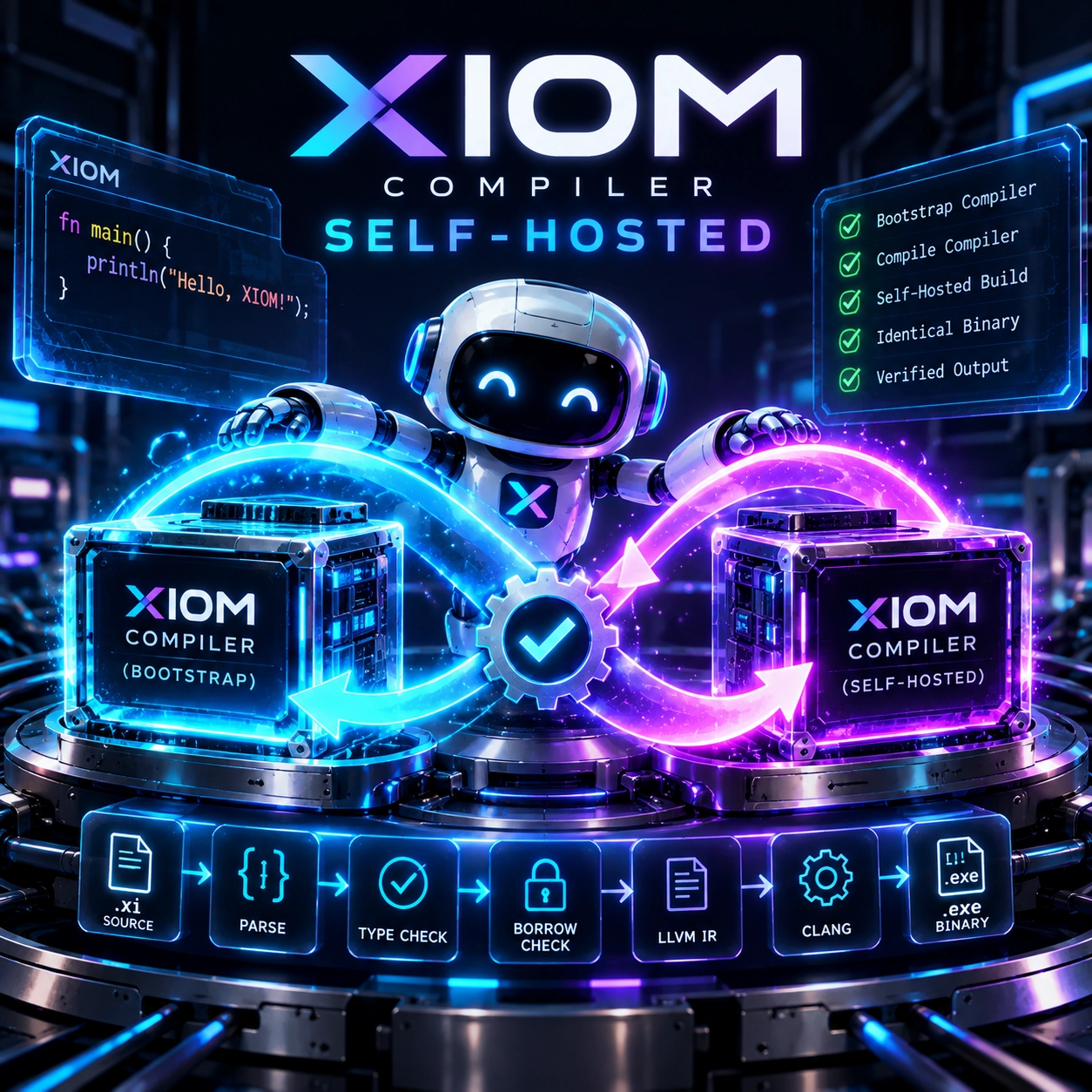
Self-hosting
Self-hosting -- compiling the compiler with itself -- is in progress. Self-hosted releases ship only once every tracked bootstrap gate is green; until then the bootstrap compiler remains the released toolchain. The gates are differential: the self-hosted compiler must match the bootstrap compiler's output -- token stream, AST and byte-identical IR on the corpus -- and the final chain requires the self-compiled binaries to be byte-identical too.
The gate table, Phase 0 evidence, blockers and gate commands live in the compiler repository: docs/SELFHOST_PROGRESS.md.
Standard library
The standard library ships with every toolchain as beta: modules are published with their known limitations, and the library leaves beta when every readiness gate is green.
The readiness definition, gate list and evidence live in the standard library repository: docs/PRODUCTION_READINESS_QUEUE.md; the smoke gates are listed under Verification gates.
Next
- First self-hosted release once the bootstrap gates reach 100%.
- Registry: more official packages as they pass the publish gate, plus the post-beta platform work (object storage, index sharding) tracked in the registry repository.
- Static contract proof integration -- SMT-LIB output is available today through
--verify. - ARM and RISC-V cross-compilation targets; macOS Intel and Apple Silicon archives ship today.
Projects
Five projects beyond the toolchain, each with its own site. Pulse is public with tagged releases; the other four repositories stay private while they harden. The pages say what works today and what is next; releases and mirror installers follow for each project like the toolchain's.

Pulse beta
The official XIOM web backend: a single-binary HTTP/1.1 service built on the published toolchain, with sessions and JWT, a crash-safe store, rate limiting, JSON access log and audit trail, and Prometheus metrics; TLS runs through nginx. Tested on all five platforms; the 0.2.2 download ships Linux x64 and Windows x64; beta, in development. One core, two forms: Beacon (the xiom.pulse package, live on the registry) is the embeddable core; Station is the standalone service.
OrbitDB experimental
An embedded database engine: B-tree index, write-ahead log, query engine and crash recovery, organised as a layered engine on the shared durable-systems substrate. Durability runs on real fsync end-to-end; hardware power-loss testing is next. Conformance 166/166 on Windows and WSL. Two-tier direction: the embedded engine (Satellite, live as xiom.orbitdb) continues as the release line; a server tier (Station) is planned on the same engine; SQL is planned for the server tier only; both pre-alpha today.

XVector experimental
A vector database engine at v1.0.0-rc.1: dense vectors with cosine, dot-product and euclidean metrics, exact flat and HNSW ANN search, typed filters and WAL-backed recovery. The embedded engine is the mote tier (xiom.vectors, live on the registry), with the scale-out 'lattice' tier in development on the same engine; cross-shard scatter-gather will follow the 1.0 release.

Benchmark of Chaos offline
A language-safety benchmark that runs the same LLM across C, C++, Rust, Zig, Go, Ada and XIOM in systems, contracts, scripting and LLM arenas, with every result bound to an image digest and a methodology contract. It runs offline from a local checkout; setup instructions are published on its site while the source and results stay offline during phase 1.

XiomEngine in development
The XIOM game engine, in early development; the repository stays private for now and the site fills in as the project opens.
The project sites are showcases; nothing is claimed that the repositories and release evidence do not support. More about the projects.
Scope
XIOM is a systems language for production use -- not a research language and not a domain-specific language. Scripting mode, JIT execution and compile-time evaluation are part of the workflow, not a separate product. See Why for the full purpose, History for how the project reached this point, and the release history for what has shipped.